Product Overview
As a leading manufacturer and supplier of advanced fluid transmission solutions, we offer the premium T type Ductile Iron Pipe, engineered for robust underground and above-ground infrastructure. Manufactured through a highly controlled centrifugal casting process, this pipe delivers exceptional longevity and structural integrity for the most demanding municipal, agricultural, and industrial projects.
- Features a push-on flexible joint for rapid, tool-free assembly
- Delivers exceptional high tensile strength exceeding 420 MPa
- Offers highly customizable internal and external anti-corrosion linings
- Strictly compliant with international ISO and EN waterworks standards
Product Description
The T type Ductile Iron Pipe, frequently referred to in the engineering sector as a Push-On Joint or Tyton Joint pipe, represents the absolute pinnacle of modern fluid transmission technology. Forged through a highly precise centrifugal casting process, a meticulously controlled volume of molten iron is introduced into a rapidly rotating cylindrical mold. The immense centrifugal force compresses the liquid metal against the mold wall, forming an incredibly dense, uniform metallic structure entirely free of microscopic voids or casting defects. Once cooled and thoroughly furnace-annealed, the pipe exhibits a smooth, cool-to-the-touch exterior that belies its massive structural strength. When you strike the surface, it produces a solid, resonant acoustic ring—a definitive testament to its flawless internal metallurgical matrix. Designed specifically to overcome the inherent vulnerabilities of traditional rigid piping, this product seamlessly blends the innate, long-lasting corrosion resistance of cast iron with the formidable mechanical toughness and ductility of steel. The self-sealing socket and spigot mechanism, cushioned by a highly resilient elastomeric rubber gasket, creates an impenetrable watertight seal. This intelligent joint design actively absorbs unpredictable ground shifts, severe traffic vibrations, and gradual foundation settlements without ever compromising hydraulic performance. By integrating this pipe into your infrastructure, municipal water grids, high-pressure sewage systems, and critical industrial pipelines remain fully operational and leak-free for decades, drastically minimizing emergency excavation repairs and safeguarding vital community resources.
Product Specifications
| Product Name | T type Ductile Iron Pipe (Push On Joint / Socket Spigot Joint / Tyton Joint) |
| Manufacturing Process | Centrifugally cast, Furnace annealed |
| Nominal Diameter (DN) | 80 - 2600 mm |
| Wall Thickness Class | K7, K8, K9, K10, K12, C25, C30, C40, C50, C64, C100 |
| Pipe Length | 5.7 - 6m (Customized Length Available) |
| Reference Standards | BS6920, ISO2531, ISO4179, ISO7186, ISO8179, ISO8180, ISO16132, EN545, EN598, EN14901, EN15189, EN15655 |
| Internal Lining Options | Portland Cement, Blast Furnace Cement, Sulphate Resistant Cement, High Aluminium Cement, Epoxy Seal, Polyurethane(PU), Ceramic Epoxy |
| External Coating Options | Zinc, Zinc Aluminium Alloy, Epoxy, Bitumen, Polyurethane(PU), PE Sleeve |
| Sealing Gasket Material | SBR, NBR, EPDM Rubber Ring |
| Tensile Strength | ≥ 420 MPa |
| Yield Strength | ≥ 300 MPa |
| Hardness | ≤ 230 HB |
| Elongation | DN80-1000 ≥10%, DN1200-2200 ≥7% |
Key Features & Highlights
When integrating the T type Ductile Iron Pipe into your comprehensive infrastructure projects, you are securing a system engineered for absolute, uncompromising reliability. The meticulous centrifugal manufacturing process guarantees a product that vastly outperforms conventional materials in both harsh subterranean environments and highly exposed above-ground installations.
- Uncompromising Structural Integrity: The precisely furnace-annealed microstructure provides exceptional material ductility, allowing the pipe to easily absorb severe impact loads, heavy traffic vibrations, and extreme internal pressure surges without fracturing or splintering.
- Acoustic and Thermal Stability: The incredibly dense iron matrix naturally dampens internal fluid flow noise, ensuring significantly quieter operation in densely populated urban settings, while maintaining strict dimensional stability across extreme seasonal temperature fluctuations.
- Zero-Leakage Assurance: The precision-engineered socket and spigot configuration compresses the elastomeric gasket uniformly along its entire circumference, creating a formidable, impenetrable barrier against both internal fluid loss and external groundwater infiltration.
- Tailored Surface Defenses: From the remarkably smooth, glass-like internal finish of ceramic epoxy to the rugged, tactile, and highly protective grip of external bitumen coatings, every surface treatment is scientifically formulated to aggressively repel chemical attacks and abrasive wear.
Joint Design & Sealing Performance
The true cornerstone of this pipe's operational reliability lies in its highly innovative T-type push-on flexible joint. This sophisticated yet elegantly simple design completely eliminates the need for cumbersome field welding, threading, or complex mechanical bolting, drastically streamlining the entire assembly process.
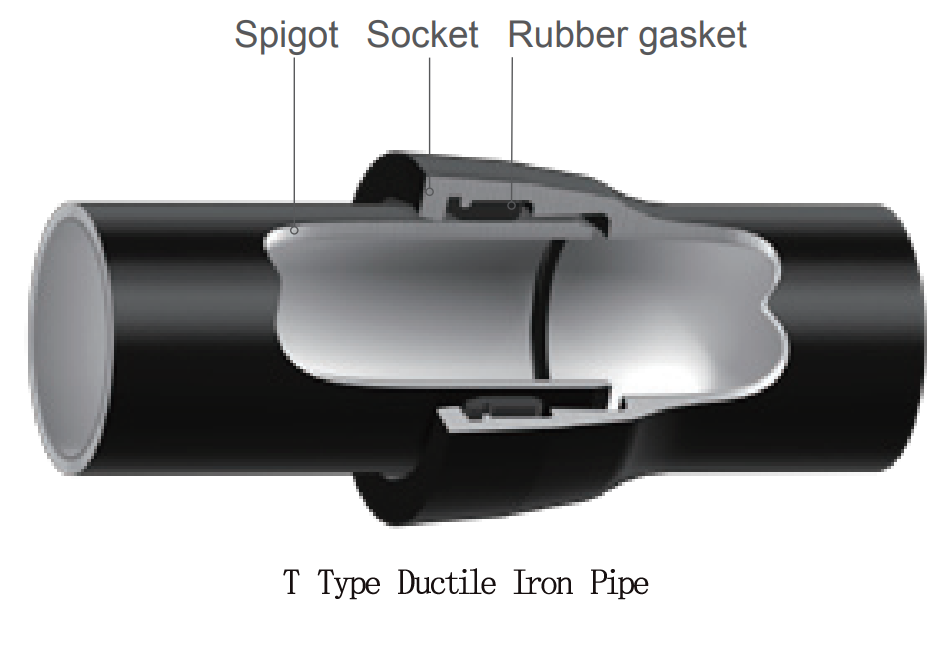
By utilizing premium-grade SBR, NBR, or EPDM self-sealing rubber gaskets, the connection achieves extraordinary, long-lasting watertightness. This intelligent joint architecture offers distinct operational advantages for field crews and system operators:
- Angular Deflection Capability: The joint safely permits significant angular movement, allowing the pipeline to gracefully navigate sweeping terrain curves and gentle undulations without requiring the costly installation of additional angled pipe fittings.
- Longitudinal Flexibility: It comfortably accommodates axial movement, naturally absorbing the immense stress generated by seasonal thermal expansion, minor seismic tremors, and gradual foundation settlement over the decades.
- Fail-Safe Hydrodynamic Sealing: As internal fluid pressure increases within the system, the hydrodynamic force actually presses the rubber gasket tighter against the metallic walls of the socket, actively enhancing the seal's integrity under heavy operational loads.
Material & Mechanical Properties
At the microscopic metallurgical level, the carbon graphite within our ductile iron is structured in spherical nodules rather than the brittle, intersecting flakes found in standard grey cast iron. This profound metallurgical transformation is the fundamental secret behind the pipe's extraordinary physical capabilities.
Project engineers and procurement specialists demand foundational materials that will not fail under unpredictable environmental stresses. This pipe delivers exceptional performance on all mechanical fronts:
- Exceptional Tensile Strength (≥ 420 MPa): It fiercely resists pulling forces and high internal hydraulic pressures, ensuring the pipeline remains completely intact even under severe hydraulic shock or sudden water hammer events.
- High Yield Strength (≥ 300 MPa): The material can easily withstand massive compression from deep trench burial depths and relentless overhead vehicular traffic without suffering any permanent structural deformation.
- Superior Elongation: With a remarkable elongation rate of up to ≥10% (for DN80-1000 sizes), the pipe exhibits steel-like flexibility, bending significantly to absorb energy before reaching its breaking point, which is absolutely crucial for installations in earthquake-prone zones.
- Controlled Hardness (≤ 230 HB): While tough enough to resist aggressive external abrasion from rocky backfill, the controlled hardness ensures the pipe can still be cut, drilled, and tapped efficiently on-site using standard utility tools.
Anti-Corrosion Coatings & Linings
High soil acidity, stray electrical currents, and chemically aggressive fluid compositions can rapidly degrade unprotected underground infrastructure. To combat this inevitability, we provide an extensive, highly specialized portfolio of internal linings and external coatings, transforming the raw iron into an impenetrable conduit.
Selecting the correct protective barrier is vital for maximizing the operational lifespan of your fluid transmission network. Our highly customizable protection options include:
- Advanced Internal Linings: Options such as Sulphate Resistant Cement and High Aluminium Cement create a smooth, highly alkaline environment that actively prevents tuberculation and scale buildup, ensuring consistent flow rates and pristine water quality. For highly corrosive industrial effluents, our Ceramic Epoxy offers a glass-smooth, chemically inert shield.
- Robust External Coatings: Active galvanic protection is provided by high-purity Zinc or Zinc Aluminium Alloy sprays, which safely sacrifice themselves to protect the underlying iron substrate. This is typically sealed with a dense Bitumen or Epoxy topcoat to completely block moisture penetration.
- Extreme Environment Solutions: For highly aggressive, waterlogged, or contaminated soils, heavy-duty Polyurethane (PU) coatings or extruded PE Sleeves provide a thick, physical armor that completely isolates the pipe from corrosive surrounding elements.
Specifications & Standards Compliance
Meeting the incredibly stringent demands of global infrastructure development requires rigorous, unwavering adherence to international manufacturing protocols. Our piping systems are manufactured and meticulously tested to exceed the most demanding industry benchmarks, ensuring absolute compatibility and safety.
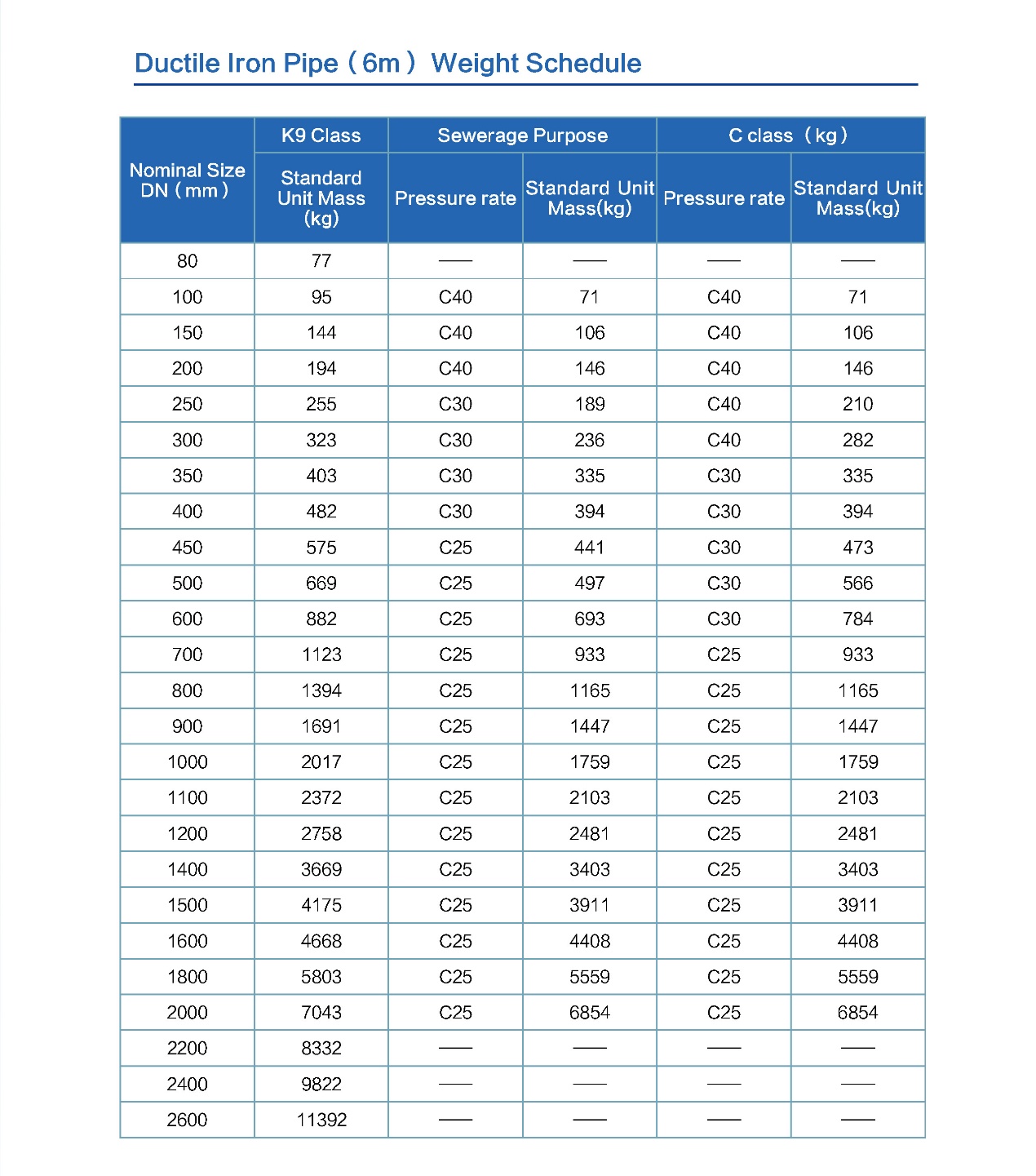
We provide comprehensive sizing and pressure class options to perfectly match your specific hydraulic calculations, flow requirements, and site conditions:
- Expansive Size Range: Available from a highly compact DN80 for local residential distribution lines, scaling all the way up to a massive DN2600 for primary regional water transmission mains.
- Versatile Wall Thicknesses: Choose from the traditional K-class (K7 to K12) for robust, highly unpredictable heavy-duty applications, or the modern C-class (C25 to C100) which is intelligently optimized for specific operating pressures, significantly reducing unnecessary material weight and handling costs.
- Global Certification: Fully compliant with critical international standards including ISO2531 for potable water applications, EN598 for aggressive sewerage, and BS6920 for the safe transport of drinking water, providing undeniable proof of quality for municipal authorities and project stakeholders.
Installation Efficiency & Cost-Effectiveness
The true, measurable value of a piping system extends far beyond its initial purchase price. The T type Ductile Iron Pipe is specifically engineered to dramatically slash on-site labor costs, accelerate project timelines, and virtually eliminate post-installation maintenance budgets.
Contractors, utility operators, and project managers consistently realize significant financial benefits through the pipe's highly intelligent, contractor-friendly design:
- Rapid Push-On Assembly: The intuitive socket-and-spigot design allows installation crews to connect large pipe segments swiftly using basic mechanical leverage tools. This entirely minimizes the need for specialized welding crews or heavy, expensive jointing machinery.
- All-Weather Installation: Unlike certain synthetic plastic pipes that require strict, dry temperature controls for thermal fusion welding, our ductile iron pipes can be reliably joined in heavy rain, deep mud, or freezing conditions, preventing incredibly costly weather-related project delays.
- Reduced Bedding Requirements: The immense inherent structural rigidity of the ductile iron pipe means it relies far less on perfectly compacted, imported soil envelopes. It can very often be laid directly in native excavated soils, drastically cutting the heavy costs associated with importing specialized sand or gravel bedding materials.
- Exceptional Long-Term ROI: With a proven, real-world service life often exceeding a full century, the annualized lifecycle cost of ductile iron is exceptionally low, providing unmatched, generational long-term value for utility operators and taxpayers alike.
Versatile Applications
The extreme adaptability of the T type Ductile Iron Pipe makes it the definitive material of choice across a highly diverse spectrum of critical infrastructure sectors. Its rugged, impact-resistant construction and fully customizable chemical linings allow it to handle everything from pristine drinking water to highly abrasive industrial slurries.
Our premium piping solutions are currently driving operational excellence and environmental safety in numerous demanding environments worldwide:
- Potable Water Networks: Safely and hygienically transmitting clean drinking water from remote treatment reservoirs directly to urban distribution grids without any risk of secondary contamination or chemical leaching.
- Wastewater and Sewage: Effortlessly handling the highly corrosive hydrogen sulfide gases and abrasive solid particulates found in municipal sewage collection and heavy industrial effluent disposal systems.
- High-Pressure Fire Fighting Systems: Providing the unyielding burst strength and thermal resistance required for critical, life-saving fire suppression networks in massive commercial and industrial complexes.
- Agricultural Irrigation: Delivering high-volume water across vast distances to sustain large-scale farming operations, easily enduring the harsh UV exposure and physical impacts of above-ground installations.
- Geotechnical Engineering: Frequently utilized as robust, unyielding piling for ground stabilization in complex architectural foundations, perfectly leveraging its immense compressive strength.
Why Choose Us
Selecting the right manufacturing partner is just as critical to your project's success as selecting the right pipe. We are deeply dedicated to empowering your large-scale infrastructure projects with unparalleled manufacturing precision, seamless logistical expertise, and profound technical support.
Here is exactly why top-tier procurement teams, municipal engineers, and global infrastructure developers consistently trust our manufacturing facilities:
- Advanced Manufacturing Facilities: We utilize state-of-the-art, fully automated centrifugal casting machines and highly precise computer-controlled annealing furnaces, ensuring every single pipe exhibits flawless metallurgical consistency and exact dimensional accuracy.
- Stringent Quality Control: From raw material spectral analysis at the foundry to rigorous hydrostatic pressure testing of the finished product, our exhaustive multi-stage inspection protocols guarantee a zero-defect rate before any shipment leaves our docks.
- Customized Engineering Solutions: We do not just supply raw pipes; we supply comprehensive fluid solutions. Our dedicated engineering team collaborates directly with you to determine the exact internal linings, external coatings, and pipe thickness classes required for your specific soil chemistry and fluid dynamics.
- Global Logistics Expertise: We deeply understand the severe financial complexities of international project timelines. Our highly robust supply chain network and secure, heavy-duty packaging methods ensure your critical materials arrive on-site, perfectly on schedule, and in pristine condition.
Frequently Asked Questions (FAQ)
To fully assist your engineering and procurement teams in making highly informed, data-driven decisions, we have compiled detailed answers to the most common technical inquiries regarding our ductile iron piping systems.
- Q1: How exactly does the push-on joint accommodate severe ground settlement?
A: The T-type joint utilizes a highly resilient, specially profiled elastomeric gasket. Once the spigot is fully inserted into the socket, the joint geometry allows for up to 5 degrees of angular deflection and slight longitudinal slippage. This built-in flexibility safely absorbs the immense stress of differential ground settlement, preventing pipe rupture while maintaining a strict, high-pressure watertight seal. - Q2: What is the fundamental difference between K-class and C-class wall thicknesses?
A: K-class (e.g., K9) is a traditional thickness classification based on a standard mathematical formula, offering a heavier, highly robust wall suitable for unpredictable or extreme external loads. C-class (e.g., C40) is a more modern, performance-based classification defined directly by the pipe's allowable operating pressure (in bar). C-class allows for highly optimized material usage, reducing weight and handling costs while still perfectly meeting specific hydraulic pressure requirements. - Q3: Which internal lining should be selected for aggressive sewage transport?
A: For standard municipal sewage, High Aluminium Cement or Sulphate Resistant Cement provides excellent, long-lasting protection against corrosive hydrogen sulfide gas. However, for highly corrosive industrial wastewater or septic sewage with extreme pH fluctuations, a Ceramic Epoxy lining or Polyurethane (PU) is strongly recommended due to its absolute chemical inertness and superior abrasion resistance. - Q4: Can these pipes be safely installed in highly corrosive, waterlogged soils?
A: Yes. For highly aggressive soil environments (such as coastal areas or industrial brownfields), standard zinc and bitumen coatings may not suffice. We highly recommend utilizing our extruded Polyurethane (PU) external coating or wrapping the pipes in a protective PE (Polyethylene) Sleeve during trench installation. These advanced methods completely isolate the iron substrate from stray electrical currents and corrosive soil electrolytes. - Q5: Are the rubber sealing gaskets resistant to microbiological degradation over time?
A: Absolutely. Our EPDM, NBR, and SBR gaskets are chemically compounded specifically for harsh underground utility applications. They are highly resistant to microbiological attack, root penetration, ozone degradation, and harsh water treatment chemicals (like high-concentration chlorine), ensuring the joint seal easily outlasts the structural design life of the pipeline itself.


